

Tired of Time Slipping Away? Make These Changes

Updated: Oct 9
Maybe it's the changing of the seasons, but the theme of the past few weeks has been a feeling of time being wasted or slipping away. Has it always moved so rapidly, so out of our control? Of all our resources, time is the most finite. So how can we learn to make friends with it and feel like we're not constantly working against it?
When clients express disappointment with their ability to work with time, I think it's important to really look at how they are spending our time and how they'd rather be spending it. Sounds simple, yes? Simple doesn't always mean easy.

Where is time going? Is it going towards lying around feeling bored, drinking excessively or over-working? These may be signs you are distracting yourself from getting what you actually want and need.
The hardest part of gaining control of your own time is learning the skill to identify what you actually want and need.
Most of us have been trained out of this skill of identifying our needs from an early age. Parents can dismiss wants/needs of children (think, "seen and not heard") or they can make the decisions for them. Older generations are more likely to have experienced authoritarian parenting which told children exactly what to do and when, "because I said so." Whereas younger generations are more likely to experience "helicopter" parents who want to reduce their children's discomfort by becoming overly involved and protective of children. Both forms of parenting remove a child's ability to identify their own needs and make their own decisions.
Learning How to Identify Needs
The Magic Wand exercise can help to explore your ideals... if you actually let yourself engage fully with it.
Imagine I just waved a magic wand and tomorrow you wake up and your life is exactly the way you want it to be. Now walk me through your day with as much detail as possible. What do you notice first thing when you open your eyes? How does your body feel? What are the actions you go through upon first getting out of bed? Then how does the day go? What do you eat and drink throughout the day? Who do you see and how do you interact with them? Go through the details in depth and don't hold back. How does work, home or school go? What does your evening look like? What is it like before you go to bed? How does it feel when you lay in bed at night?... Now what is one small change you can make today to make your life look more like how you want it to?
In order to feel in control of our time, we have to know what we want (our goals) and what we need (how to resolve our uncomfortable emotions). To know what we want and need, we have to allow ourselves to explore our thoughts, emotions and bodily sensations and read the messages they are trying to tell us. Does it feel pleasant or unpleasant to spend your time doing different things? How does it feel when you accomplish different goals, or aren't quite meeting your goals? For more on understanding needs and wants, check out this post.
Let's start with how we spend our time
It's good to take an honest inventory about how you have been spending your time, and see where you can take out the things that aren't so important to you and replace them with the things which are. I'm talking again about boundaries (I know, I'm so predictable... how boring). We have to have boundaries with our time in order to gift ourselves the ability to engage in what we actually want and need. Instead of thinking of boundaries with time as shackles of commitment to rigidity, I'd like us to think about them as guidelines for focus.
One of the biggest conversations I have with clients about time is on phone/screen use. If you are feeling like you are tumbling through time with no ground to stand on, my guess is you spend a significant amount of time on your screen. Go ahead and look at your screen time report and let's go from there. If you are spending even 4 hours on your screen a day (the average for adults), that is 28 hours a week. Over an entire day is spent staring at a screen every week. I get that some of that time may be connecting with others, or doing something actually useful. For a lot of people though, it's going to be social media or other forms of entertainment. (Did you know the average teen spends 7 hours a day on a screen solely for entertainment~ that's a time commitment of 106 days out of a year, without sleep!)
It's important we don't shame ourselves over phone use. Phones are made to be addictive and keep you on as long as possible. We all know this, and having the impulse throughout the day to distract ourselves with scrolling isn't a personal failing, it's just our brains working with our phones in a very predictable way. But is your time on your phone in alignment with your own values and goals?
Consider your own personal boundaries with yourself around phone use. Are you reaching for the phone because you want to avoid necessary tasks? How about to avoid uncomfortable thoughts and feelings? Are you looking for a quick dopamine hit to sooth yourself in a stressful moment? These behaviors are common. So start allowing yourself a pause between the impulse and the action. Consider what you actually want to be spending your time on or how you can resolve uncomfortable feelings rather than distracting yourself from them. If having full access to your phone is something which feels like a trap for you, set up screen time limits. Apps such as Jomo can help set more specific limitations.
Let's consider how we want to spend our time
So how do we create boundaries with time? Let's be realistic with our ability to implement changes and become a scientist to our own experience. Here's a weekly schedule template:

Notice how there are freetime choices (what do I enjoy when I have spare time), and a block for goals and values (what is important to me at this moment). Some basic scheduling is setting sleep, wake and eating times. You may already have portions of your schedule filled out too, like for work, volunteering, social commitments like clubs, taking care of dependents... Put those in and then see what you have left over.
Then, start plugging in the activities you've been wanting to get around to but just haven't "had the time for". Your values and goals guide these plug-ins. How frequently do you want to spend time with friends, read, create, exercise, have a bath? Put those in somewhere if they are important to you.
Here's an example of my own (old) weekly schedule for reference:

Notice how I wrote mine in pencil! This is because you may come up with some great idea on what you might think would work for you, but in being a scientist to your own experience, you realize an incompatibility. Waking up at 5:30 in the morning is physically impossible and miserable for you! That's okay, because you know what? You are the boss of your schedule and you are allowed to change it! How fun is that?
We demonstrate daily what is important to us through how we choose to spend our time.
What if I don't know what is most important?
If you struggle with prioritizing, you are not alone! One tool I like to share is the urgent-important matrix, or The Eisenhower Matrix.
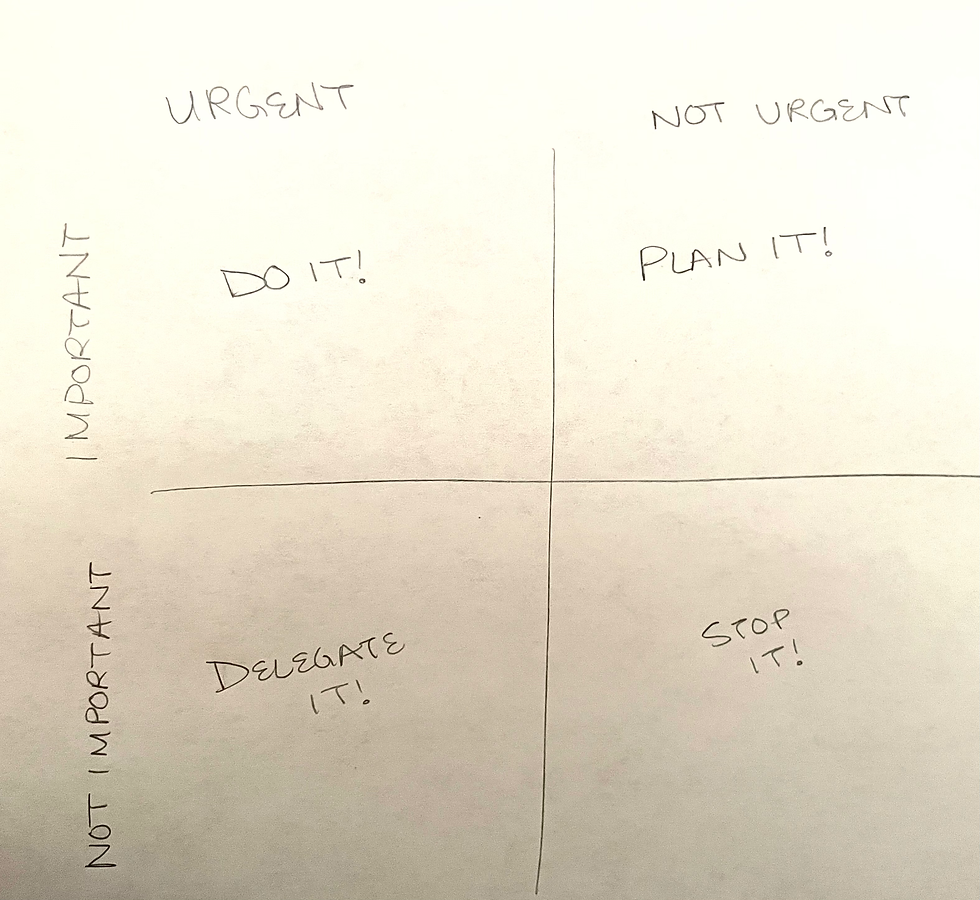
This model, developed for business, can be applied to all life. If something is urgent and important, do it! If it is something which is important but doesn't need done right away, plan a time to do it. If it is not important for you to do, but it is urgent, then delegate it (an example would be hiring a cleaner for your home, or asking your kid to do the dishes). If it is not urgent and not important (think spending hours on social media) then just stop it.
Things which are not urgent, but important will eventually move over into the urgent-important category. Maybe it's not urgent to take a shower, but eventually it becomes urgent.
Simple rules
Here are some simple rules you can implement to get more control over your time. You have to actually do them for them to work, though.
If something can be done in less than 5 minutes, do it!! This rule prevents us from compounding undone tasks, which later can become overwhelming.
Write to-do lists in the morning, focusing on what is most important for the day. This helps you to focus your use of time.
Set timers! If you want to scroll on your phone, that's okay, but give yourself some limits.
Set alarms! Especially if you find yourself being forgetful or struggling to be on time, set alarms to help you.
Use a calendar/day planner. Having a larger view of your time throughout a week or month can help you to understand how much time you actually have and what is essential to accomplish.
The simple rules sound pretty basic, but they help us to develop a relationship with time and prioritize our actions. Developing a relationship with time does not mean you have to be overly productive. We all need time for rest, to let our minds wander, and to engage in activities with no end-goal. Allowing ourselves these seemingly indulgent activities helps to restore our brain function and activate different systems in the brain.
The most important take away here, is making the choice of how you want to spend you time. If you are choosing to lay on the couch for an hour and scroll on your phone, then you have become empowered; if you are however, falling into habits and impulses without choosing, time is always going to feel like it's escaping you.


Comments